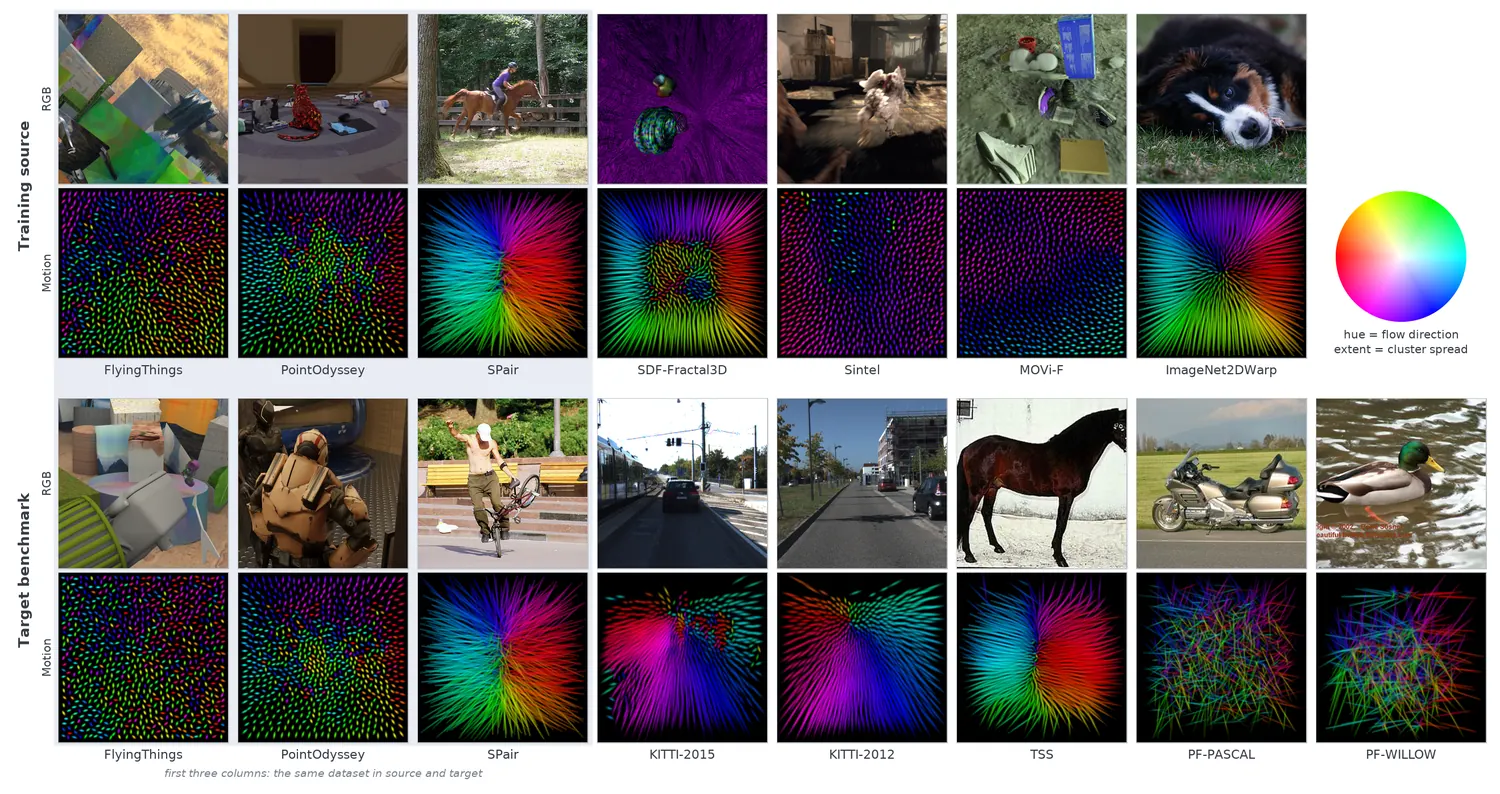
Every dataset gets a motion fingerprint
Represent where a correspondence starts and how it moves. Pool those compact descriptions across image pairs to measure the motion a dataset supplies.
01 · THE REPRESENTATION
One correspondence. Four numbers.
A flow field supplies a displacement at an image location. A sparse keypoint pair supplies the same information: subtract its starting coordinate from its matching coordinate. BFV puts both into a common space:
Position tells us where; displacement tells us how far and in which direction. Magnitude is √(Δx̂² + Δŷ²), and direction is atan2(Δŷ, Δx̂). Encoding the two displacement components retains both without choosing angle or magnitude bins. A zero displacement has zero magnitude and no defined direction.
This is a compact description of annotated image-space motion. It requires no RGB pixels, learned descriptor or object category. For semantic keypoints, “motion” means the displacement between corresponding parts across images, even when they belong to different objects.
02 · FROM PIXELS TO SHARED UNITS
Normalize the coordinate system, not the arrow’s length.
The paper crops images to a square, then expresses locations and displacements in units of that image. Coordinates must refer to the cropped frame, with correspondence annotations transformed consistently.
x̂ = 2x/W − 1
ŷ = 2y/H − 1Δx̂ = 2Δx/W
Δŷ = 2Δy/HThe image center maps to (0, 0); its edges map to −1 and +1. A displacement of +1 means half an image width or height, not one pixel. The displacement components can exceed 1: they are differences between normalized coordinates. We do not rescale every arrow to unit length, which would erase magnitude.
Try the normalization
Move either endpoint with the controls. Then change the image size: pixel values change, but the BFV stays the same.
Illustrative coordinates · orange = start, teal = match
Resolution invariance means the same relative correspondence has the same encoding after a consistent resize. A different crop or a different set of sampled frames can still change the distribution. Frame order matters too: swapping a correspondence moves its anchor to the other endpoint and reverses its displacement.
03 · WHY KEEP POSITION?
The same arrows can describe different motion fields.
A direction histogram could count equally many leftward and rightward vectors in both an expanding and a contracting field. Their magnitude distributions can match too. What differs is where those vectors occur. BFV retains that relationship by keeping position and displacement together in each row.
Direction + magnitude: identical.
Joint position + displacement: different.
Both panels contain the exact same eight displacement vectors and the same eight starting positions. Reassigning vectors changes which motion belongs to which location.
Displacement bags match; BFV bags differ.
BFV has no predefined spatial cells. Nearby correspondences can be compared continuously in four dimensions. It preserves the relation between a vector and its location, but does not retain which neighboring vectors came from the same image.
04 · FROM ONE PAIR TO A DATASET
The bag is a dataset-level empirical distribution.
Pool the retained annotation vectors across the dataset. One point in BFV space represents one correspondence—not an entire image pair. The bag discards row order and image identity, but preserves the observed distribution of positions and displacements. It is not a mean arrow: opposing motions do not cancel into a stationary dataset.
Dense flow contributes vectors at labeled pixels; sparse matching contributes vectors only at its annotated keypoints. Unannotated locations do not become zero-motion examples. Annotation validity, extraction filters and sampling determine which vectors enter the bag. Pooling by vector is also different from assigning equal weight to every image, so supervision density and the sampling protocol matter.
The representation lets a synthetic source and a real benchmark live in the same motion space, even if one contains rendered objects and the other contains sparse animal keypoints. That does not make the tasks identical; it makes their annotated displacement statistics comparable.
What the fingerprint picture shows
The paper’s splats summarize clusters of pooled vectors. Hue indicates dominant direction; extent shows cluster spread. They are a visualization of the bag, not the features used to compute distance. The small RGB example above each fingerprint is only an example image, not the whole dataset being summarized.
What BFV leaves out
Texture, lighting, object identity, image grouping and temporal ordering are absent. BFV alone cannot uniquely separate camera motion from object motion, or guarantee that a requested collection of vectors forms a realizable scene.
05 · WHY THIS HELPS TEST THE THESIS
Compare what datasets supply before training a matcher.
BFV isolates a compact motion hypothesis: perhaps transfer depends on the displacements a source supplies, not only on the appearance of its images. The paper separately represents appearance with DINOv3 patch features and compares both representations with distribution distances. BFV itself is a representation, not a transfer score.
Next, coverage asks whether each target vector has a nearby source vector. The reverse direction asks how much source motion is unlike the target. These are dataset comparisons over the bags; no correspondence between individual source and target images is required.
Optional context: how does this differ from HOF?
A histogram of optical flow summarizes motion with bins. The HOF implementation explored in this project uses spatial cells, direction and magnitude bins, plus an occupancy channel. It can retain coarse spatial structure, but requires choices about bin boundaries and grid resolution.
BFV keeps individual continuous position–displacement samples. Its four values are per correspondence; they are not the dimensionality of a fixed-size descriptor for an entire dataset. This is a representation tradeoff, not a claim that BFV universally outperforms histograms. HOF is not needed to follow the main BFV argument.
The fingerprint figure shown on slide 15