Motion moves transfer; appearance barely does
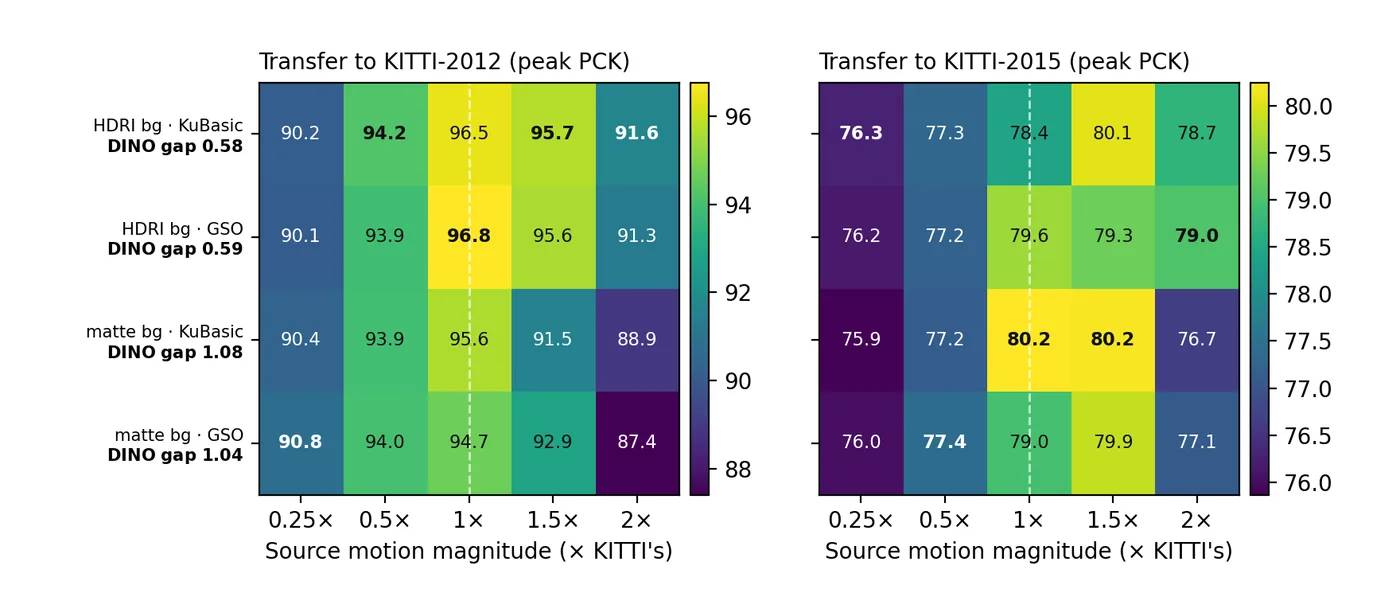
Controlled grid: the same 5,000 Kubric scenes; sweep camera-motion magnitude against appearance variants; evaluate on KITTI. Transfer peaks at the coverage match and drops 5–11 PCK away from it, in every appearance row. Along the appearance axis: nearly flat. The most photorealistic variant has no consistent edge over flat-shaded primitives.
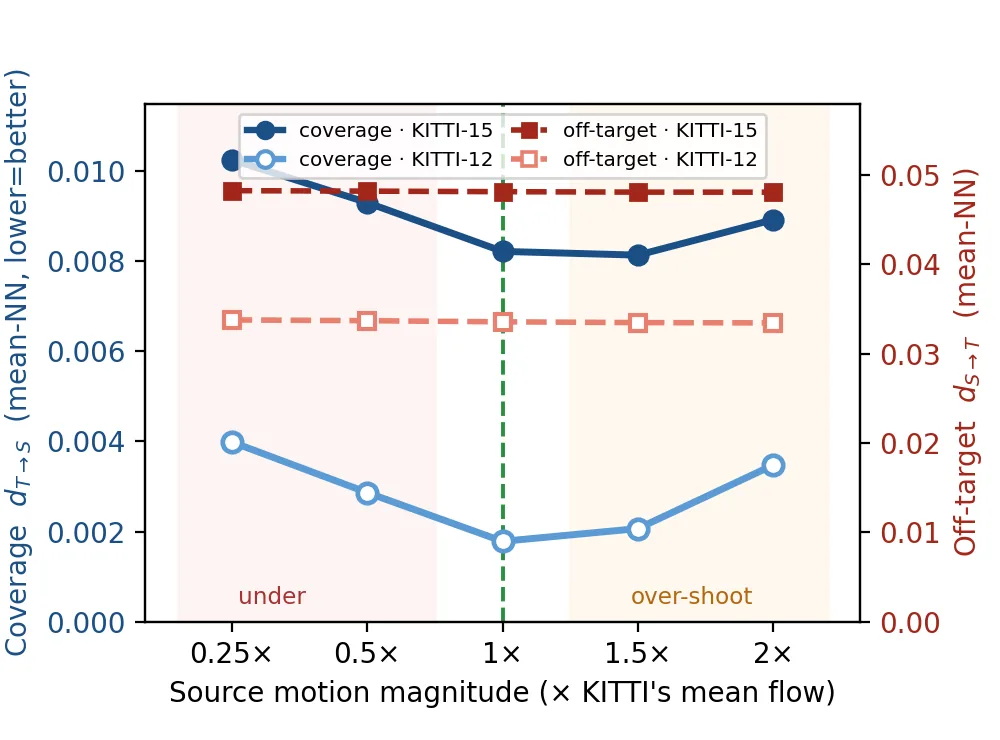
More: coverage and off-target along the motion axisfigure
The Kubric Grid
Twenty training sources from the same scenes: four appearance variants × five camera-motion magnitudes. Tap a cell to see the pair and its motion; the heat map is transfer to KITTI.
rows = appearance, columns = source motion magnitude (× KITTI's mean flow); numbers = peak PCK@5% after training on that source
coverage d(T→S), lower = closeroff-target d(S→T)solid = KITTI-2012 · dashed = KITTI-2015 · mean over the four appearances, each on its own scale
frame 1 + ground-truth motion
the same flow as colour (hue = direction, brightness = magnitude, one shared scale)
Content held fixed, two knobs varied. Transfer peaks where the source's motion magnitude matches KITTI (where coverage dips) and falls 5–11 PCK away from it, in every appearance row. Along the appearance axis the rows are nearly flat: HDRI lighting with scanned GSO assets has no consistent edge over flat-shaded primitives on a matte background. The generator's motion, not its look, decided the transfer.