The pharmacist and the generator
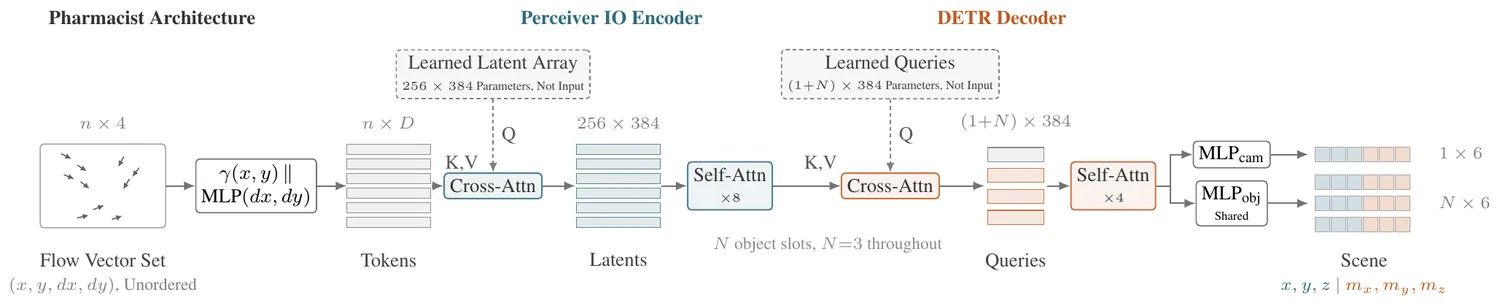
The pharmacist grounds each ideal request in a realizable scene; the generator renders it with exact labels. The pharmacist uses a Perceiver IO encoder and a DETR-style set decoder. Motion vectors enter only as keys and values, so the read is permutation-invariant and linear in set size; each object query emits placement and motion as one committed six-vector. Trained on near-uniform renders so it carries minimal bias toward any motion regime. Round-trip A→B→A median error is exactly zero at 1 px quantization.
Move the orange piece into target A.
Two objects already fit. Drag the orange disc onto the dashed circle, or use the button below.
Show the matching and the cost calculation
This flat puzzle uses |Δx| + |Δy| + 2(|Δmotion-x| + |Δmotion-y|), in scene units. The training model uses full 3D placement and motion vectors; this is a simplified 2D illustration.
The highlighted cells form the cheapest one-to-one assignment, found by checking all six pairings. Reordering rows cannot change that minimum.