Where each addition lands in motion space
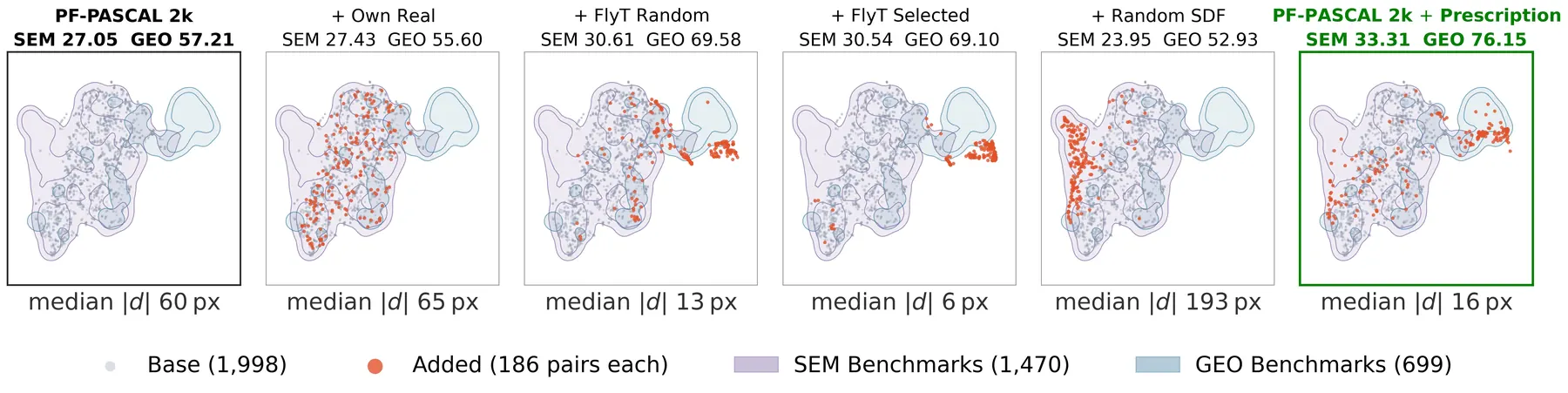
One UMAP of per-pair motion, fitted once, filtered per panel. Explore the training sets and their additions below; the original PF-PASCAL figure from the slide is also available here.
PF-PASCAL: the figure shown on slide 32slide reference
Loading the saved motion-space map…
Expanded companion fit · 13 training sets. This shared layout differs from the slide’s PF-PASCAL-only figure. Up to 1,000 cached pairs are sampled per cloud.
One dot = one image pair. All panels use the same coordinates and scale. Grey is the base; colored points are added pairs. Faint purple and blue points show benchmark context.
How this map relates to the slide
This is a new companion-only UMAP over the available cached pairs from all 13 training sets and their additions. It uses the same 14 per-pair motion features as the paper’s visualization, with one standardization and one unsupervised fit. Its layout differs from the PF-PASCAL-only figure on the slide. Switching datasets, additions or visibility never refits the map.
Up to 1,000 pairs are uniformly sampled from each cached base/addition cloud with a fixed seed. Counts and median displacements describe those plotted pairs; they are not accuracy scores or a replacement for the experiment’s training-set sizes. Each addition uses its existing prescribed-dose cache. The cache does not contain every comparison arm for every base.
Read the map qualitatively. UMAP axes have no physical units and plotted distances are not coverage measurements. The displacement readouts are computed from the original motion features, in a 512-pixel frame. The benchmark points are context for the visualization, not input to the doctor’s prescription.
Download map data and provenance (JSON) ↓